Fifty Singles 1. Ariel Pink's Haunted Graffiti- Round and Round 2. Jam City- Ecstasy Refix 3. Balam Acab- See Birds (Moon) 4. Starkey- Stars 5. Cut Copy- Where I'm Going 6. Darkstar- Gold 7. Girl Unit- Wut 8. Raffertie- 7th Dimension 9. Jamie XX- Far Nearer 10. Roska and Untold- Myth 11. Deadboy- If U Want Me /If U Want Me (Brackles and Shortstuff mix) 12. El Guincho-Bombay 13. Delorean- Stay Close 14. Kanye West feat Pusha T- Runaway 15. Azari & III- Indigo 16. Bob Holroyd- African Drug (T. Williams Keye Mix) 17. Hackman-More Than Ever 18. Wiley and Chew Fu- Take That 19. Cee-Lo- Fuck You 20. Forest Swords- Rattling Cage 21. Lando Kal- 3d Action Jackson 22. KOF- Fire It Up (Funkystepz mix) 23. Rihanna- Rude Boy 24. John Foxx- Flightpath Tegel 25. High Places- Can't Feel Nothing 26. Submerse- Stay 27. Deftones- Sextape 28. Drake- Fireworks 29. Cosmetics- Black Leather Gloves (20JFG mix) 30. Grouper- Hold 31. The Dream- Yamaha 32. Skream- Where You Should Be 33. Dennis Ferrer- Hey Hey 34. Neon Indian- Sleep Paralyst 35. Janelle Monae- Tightrope 36. Altered Natives- Rass Out 37. Factory Floor- A Wooden Box 38. Jamie Vex'd- Saturn's Reply 39. The End of All Existence- The End Of All Existence 40. Scuba- Before 41. LD- Shake It 42. Ok Go- This Too Shall pass 43. Active Child- Wilderness 44. Here We Go Magic- The Collector 45. Low Sea- Never Yours 46. Pearson Sound- Down With You 47. D-bridge- Love Hotel 48. Keepaway-Yellow Wings 49. Conforce- Intimidation 50. Ke$ha- Tik Tok
Here's Zizek's article that Lethem quotes liberally from in the book.
A few other notes:
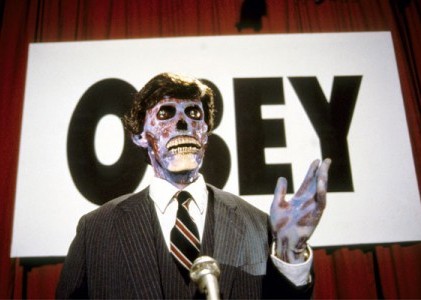
1. With regard to the infamous fight sequence, Lethem goes to great lengths to try to unlock its power and justify its existence. I’m still not entirely convinced that the whole sordid ordeal wasn’t just a contractual obligation either by the studio or Roddy Piper’s agent that ensured he be given ample time to showcase his wrestling skills in the film. Perhaps, such a contract did exist and Carpenter decided to make it the most ridiculous thing in the world as payback, “wagering the film’s whole stakes decisively on a pop culture/’termite art’ bet”, as Lethem says.
In the end, the best justification for its existence though is Zizek’s; “Liberation hurts. You have to be forced to put on the glasses”. For Frank, being black in America is hard enough. He feels that he doesn’t need the extra struggle, the middle class malaise of living amongst superficial hideous monsters. Solidarity with white America undercuts minority struggle because it’s ultimately white values which are always given political urgency. It's thus best for black America to invent its own mythology about its detachment from power. All the conspiratorial hubbub (seen all over the place in hip-hop literature) about the illuminati and William Cooper (detailed excellently in Jeff Chang's Can't Stop Won't Stop) contains a hint of truth, the conspiracy is there (see Julian Assange's essay linked to below), but it's nothing so obvious as a secret society or a specifically totalitarian ideology.
In order to be so hesitant, Nada has to at least expect that something awful lingered on the other side, enough to drive a man who just a day previously said he “believes in America” to go on a shooting spree.
2. In the chapter Los Angeles Plays Itself, Lethem documents briefly the history of Hollywood’s resentment toward television as a systemic complex of cultural degradation, ignoring its own complicity in such affairs. Yet, in They Live, the inclusion of Hollywood in its invectives would not only ring hollow (being a stupid horror movie and all), but also carry with it the unwanted side effect of self-reflexivity, posing the cognitive arena as an ironical field, a lark almost. In order for They Live to be successful, it has to be played completely serious (all hammy one-liner puns aside). After all, They Live is not a farce, but a tragedy posing as a farce.
3. Lethem has good fun poking fun of the cheapness of the sunglasses (Hoffman Lenses), which is fine, but there does seem to be a pretty practical reason for them being so cheap (apart from prop department budget constraints)- they’re being made in private on the black market by what seems to be at best pretty blue collar revolutionaries. In all likeliness, the lack the financial capital (not to mention the aesthetic finesse) to fashion Ray-Bans at the drop of a hat.
4. Holly’s motivation does remain a mystery throughout, as Lethem briefly points out. Is she a spy the whole time? Has she been bribed with something that makes betrayal of the species that much easier a la Drifter? Or is genuinely loyal, being in a comfy middle/possibly upper middle class position for the local TV affiliate? One would think the ghouls would never allow anyone human too close to their precious signal unless they were certain they could be trusted not to blow up the satellite dish. Holly seems to “know” as much as Nada, but her allegiance remains with the ghouls. She’s quite believable when Nada first accompanies her to her apartment and she gets down on her knees stating “I’ll do anything you want.” Perhaps, she prefers subjugation, playing master and servant, if you will. If power is indeed sexy, as Hollywood continually tells us it is, does our compliance with it suggest that the obedient get a sadomasochistic thrill? Consider the following by Deleuze and Guattari, cited several times before by K-Punk: (quote)
"The English unemployed did not have to become workers to survive, they – hang on tight and spit on me – enjoyed the hysterical, masochistic, whatever exhaustion it was of hanging on in the mines, in the foundries, in the factories, in hell, they enjoyed it, enjoyed the mad destruction of their organic body which was indeed imposed upon them, they enjoyed the decomposition of their personal identity, the identity that the peasant tradition had constructed for them, enjoyed the dissolutions of their families and villages, and enjoyed the new monstrous anonymity of the suburbs and the pubs in morning and evening."
5. Lethem tries to find a precedent in Drifter’s speech about how “there ain’t no countries any more” and how the ghouls already own everything, citing it as kind of a birth pang to the nascent globalization movement that surround the Berlin IMF conference in 1988, which was after production on the film ceased. But Lethem fails to recognize that this speech bares a slight resemblance to the one given by Ned Beatty to convert Peter Finch’s Howard Beale in the 1976 film Network. As owner of the conglomerate that operates Beale’s network, Beatty’s speech is the perfect enunciation of postmodern financial capital a good 4 or 5 years before at happen, back it was just a neoliberal fantasy. Beatty espouses that the real nations of the world are DuPont, Dow, Union Carbide, IBM, ITT, AT&T, and Exxon; “ one holistic system of systems, one vast and immane, interwoven, interacting, multivariate, multinational dominion of dollars.” The world is thereby subject to the “immutable bylaws of business” and hints, a la Fukuyama roughly 15 years later, that all of history has been pushing in this direction for a long time. “The world is a business, Mr. Beale. It has been since man crawled out of the slime.” And the world is now so close to achieving its end, to become an “ecumenical holding company, for whom all men will work to serve a common profit, in which all men will hold a share of stock, all necessities provided, all anxieties tranquilized, all boredom amused.” Sound familiar?
During the film’s “perfect sequence”, Nada encounters a ghoul paying for a newspaper with money that declares “This is Your God”. It’s also notable that Finch’s Beale ends this exchange with Beatty by confirming his faith in the beautiful and perfect math of the markets: “I have seen the face of God”.
I edited this significantly cool feature, which you should read in its entirety and then listen to all of the music associated with it. Big up colleagues David Abravanel, Jason Cook, Mike Newmark, Alan Ranta, and Dominic Umile.
There's little to say about Julian Assange's arrest today sexual assault charges. It'd be naive to assume these are trumped charges, despite their convenience to the authoritarian regimes who'd like to eradicate WikiLeaks from the planet and resume business as usual with regards to state secrecy. Assange, like anyone, is fully capable of doing what he has been accused of and all one can really hope for in this instance is a fair and unbiased trial where justice is ultimately served, be he guilty or not.
The question then is not whether the UK is right in cooperating with extradition, but whether the UK would have extradited just anybody on rape allegations? What about Roman Polanski? Would they arrest and extradite others, such as Henry Kissinger, wanted for War Crimes in several countries?
One could never uneqivocally proclaim that the charges filed against Assange, the Manchurian Candidate, have political timing, but come on, could it be any more bleeding obvious? The U.S. and the other world powers being scrutinized by the leaks know the rape charges have exactly zero to do with WikiLeaks the organization. Furthermore, so does the media. But both institutions also know that the public's faith in ad hominem arguments guarantees that all it takes to discredit an ideology (here, Wikileaks) is to deface the public persona of said ideas.
With Assange out of the picture, Visa and Mastercard acted quickly to cut off the site's source of revenue, online donations, establishing that the old order is still in charge. It may just be a matter of weeks before the site is cut off completely, having spent the last week or so swapping servers until being discovered. These governments are quite naive though if they think this is the end of information leaks. It's only a matter of time before something else replaces it. They've got a million different mirrors and a million different names for it. You can't shut up everyone.
Incredibly saddened to hear of Peter "Sleazy" Christopherson's passing. Coil music's had an incredible impact on me and did wonders to shape my musical palette, all for the better. I will deeply miss hearing new things from him in whatever incarnation he happened to be in. I hope to write more about Christopherson in the near future, but for now please enjoy some of the great tunes below, which show just a piece of his incredible breadth.
David Bevan at Pitchfork has a really interesting column on the newer uses of voice manipulation. Seems interesting in relation to my Radiohead article. Bevan does trace a lineage, but does note exactly get at what makes these newer uses unique, the ways in which the whole concept of vocals in a song becomes wraith-like in and of itself. In these tunes, there's the distinct sense that the joy of Western song has already been depleted, that the desire to sing like that is itself an extinct precarity, that times have becomes so sad (Burial) or confusing (James Blake) that the voice can only be memorialized or sacralized (the gigantic church of sound that is Balam Acab's "See Birds").
Also, Simon R has tipped me off to this new project from K-Punk, which set sites at audio hallucinations and other perversions of the voice.
Obviously, there's tons of examples of this phenomenon, but here's a few more examples:
It's kind of amazing how the discontent of a slim minority of independents always seems to garner so much lip-time, while the vast number of people not voting in any given election is scarcely even mentioned, just assumed.
-----
Elsewhere, I discovered this fantastic lecture by David Harvey that attacks the whole of the crisis and puts it in surprisingly lucid terms.
Choice cuts:
On how the crisis originated out of a need to resolve tensions leftover by the postmodern fictions created by neoliberal policy status post the 1970s recession:
"The current crisis originated in the steps taken to resolve the crisis of the 1970s. These steps included:
(a) the successful assault upon organized labor and its political institutions while mobilizing global labor surpluses, instituting labor-saving technological changes and heightening competition. The result has been global wage repressions (a declining share of wages in total GDP almost everywhere) and the creation of an even vaster disposable labor reserve living under marginal conditions.
(b) undermining previous structures of monopoly power and displacing the previous stage of (nation state) monopoly capitalism by opening up capitalism to far fiercer international competition. Intensifying global competition translated into lower non-financial corporate profits. Uneven geographical development and inter-territorial competition became key features in capitalist development, opening the way towards the beginnings of a hegemonic shift of power particularly but not exclusively towards East Asia.
(c) utilizing and empowering the most fluid and highly mobile form of capital – money capital – to reallocate capital resources globally (eventually through electronic markets) thus sparking deindustrialization in traditional core regions and new forms of (ultra-oppressive) industrialization and natural resource and agricultural raw material extractions in emergent markets. The corollary was to enhance the profitability of financial corporations and to find new ways to globalize and supposedly absorb risks through the creation of fictitious capital markets.
(d) At the other end of the social scale, this meant heightened reliance on “accumulation by dispossession” as a means to augment capitalist class power. The new rounds of primitive accumulation against indigenous and peasant populations were augmented by asset losses of the lower classes in the core economies (as witnessed by the sub-prime housing market in the US which foisted a huge asset loss particularly upon African American populations).
(e) The augmentation of otherwise sagging effective demand by pushing the debt economy (governmental, corporate and household) to its limits (particularly in the USA and the UK but also in many other countries from Latvia to Dubai).
(f) Compensating for anemic rates of return in production by the construction of whole series of asset market bubbles, all of which had a Ponzi character, culminating in the property bubble that burst in 2007-8. These asset bubbles drew upon finance capital and were facilitated by extensive financial innovations such as derivatives and collateralized debt obligations."
On (late) capitalism's long-term survival rate:
"Can capitalism survive the present trauma? Yes. But at what cost? This question masks another. Can the capitalist class reproduce its power in the face of the raft of economic, social, political and geopolitical and environmental difficulties? Again, the answer is a resounding 'yes.' But the mass of the people will have to surrender the fruits of their labour to those in power, to surrender many of their rights and their hard-won asset values (in everything from housing to pension rights), and to suffer environmental degradations galore to say nothing of serial reductions in their living standards which means starvation for many of those already struggling to survive at rock bottom. Class inequalities will increase (as we already see happening). All of that may require more than a little political repression, police violence and militarized state control to stifle unrest."
You're obviously seeing this in Greece and France and American conservatives seem intent on ridding the earth of "unsustainable" pensions over here, particularly the defined benefit plans which rely on set formulas to determine payouts. It's unlikely pensions will be disintegrated by sweeping federal legislation though. More than likely, it'll be a confederated platform of gradualized slash and burn, state by state business by business. One of the great strength of American capitalists is their ability to make the deferral of earned and hard-fought rights so subtle that the larger populace forgets that they even had these rights to begin with, and thus avoiding the need to resort to statist repression, which almost inevitably carries with it a democratic backlash. Best to avoid the backlash (and the democracy) altogether by assigning middle management the task of de-libertizing the general population.
On the narrow sight of diagnosticians of the crisis and its defeat:
"We urgently need an explicit revolutionary theory suited to our times. I propose a “co-revolutionary theory” derived from an understanding of Marx’s account of how capitalism arose out of feudalism. Social change arises through the dialectical unfolding of relations between seven moments within the body politic of capitalism viewed as an ensemble or assemblage of activities and practices:
a) technological and organizational forms of production, exchange and consumption
b) relations to nature
c) social relations between people
d) mental conceptions of the world, embracing knowledges and cultural understandings and beliefs
e) labor processes and production of specific goods, geographies, services or affects
f ) institutional, legal and governmental arrangements
g) the conduct of daily life that underpins social reproduction.
Each one of these moments is internally dynamic and internally marked by tensions and contradictions (just think of mental conceptions of the world) but all of them are co-dependent and co-evolve in relation to each other. The transition to capitalism entailed a mutually supporting movement across all seven moments. New technologies could not be identified and practices without new mental conceptions of the world (including that of the relation to nature and social relations). Social theorists have the habit of taking just one of the these moments and viewing it as the “silver bullet” that causes all change. We have technological determinists (Tom Friedman), environmental determinists (Jarad Diamond), daily life determinists (Paul Hawkin), labor process determinists (the autonomistas), institutionalists, and so on and so forth. They are all wrong. It is the dialectical motion across all of these moments that really counts even as there is uneven development in that motion."
On the futility of decentralized leftist efforts:
"Broad adhesion to post-modern and post-structuralist ideas which celebrate the particular at the expense of big-picture thinking does not help. To be sure, the local and the particular are vitally important and theories that cannot embrace, for example, geographical difference, are worse than useless. But when that fact is used to exclude anything larger than parish politics then the betrayal of the intellectuals and abrogation of their traditional role become complete."