Wednesday, July 18, 2012

It Takes a Nation of Indifference to Hold Us Back


Like Austin Cooper, I was 9 years old when I first heard Public Enemy.   I too was a bit of a hip-hop novice at the time.  The first “rap” (as we used to call it back in the day) song that mattered to me had come out two years previous, Run DMC’s cover of the “Ghostbusters” theme, but I largely ignored the genre after its gangsta phase became polarizing to my white suburban reflexes.    

Still, during this timeframe, I was able to conceive of an era three years before I was born.  It did seem distant, but the music of Led Zeppelin, Pink Floyd, Aerosmith, and later oddball eggheads like PIL, Throbbing Gristle, Brian Eno, and Joy Division often spoke to me in a language that seemed more palpably vibrant and understanding of the complexity of teenage disconnection than the angsty grunge and virulently macho gangsta of the time.


Though it was the merger of metal (which I loved) and hip-hop (with which I was only familiar) that brought me to that same collaboration track that Austin Cooper used as curated background noise for his Tony Hawke sessions (see above), it was the wailing atonal sirens of “Lost at Birth”, the righteous indignation and dread-filled creeping stagger  of “By the Time I Get to Arizona”,  and the both poetic and psychedelic mixture of news clips, chaotic dialogue, and black music history sound samples  that made Apocalypse 91 a game-changing event for me.   It was an album that sounded like a Riot Goin’ On, like the walls caving in.   It wasn’t music that clicked, but music that sounded like something was wrong, like the comfortable suburban world I had been raised in wasn’t the only one out there. 

When NPR threw Cooper out in front of the bus to publish a “them kids” review of Public Enemy and Cooper came back with a middling “not feeling it” determination, the internet predictably responded with disgust and vitriol.  I’m not here to join the stampede against poor Cooper, who is obviously in way over his head.  He’s obviously a victim of NPR’s pursuit to drive high traffic towards low-level content.   I do think however that it is important to respond to this retort in The Guardian by Alex Macpherson.

Macpherson’s argument is that Cooper is defying the albatross of the “canon” by his gleeful ignorance of it and we should all applaud anyone who has the ability to navigate the wild turf of the internether without the imparted judgment of received wisdom.  If this was the whole story, I’d certainly be on board.   No canon should be writ in stone and it’s important to issue punctual swipes at illegitimate authority when it rears its head from a high above altar. 

The problem is that Cooper’s article doesn’t follow this model at all.  Chuck D’s cited denunciation of the canon (“Elvis was a hero to most/ But he never meant shit to me”) carried with it the context of the history that followed, which allowed Elvis to prosper and the black artists he coopted to flounder or die penniless (“Straight up racist that sucka was”).  These same grounds for critique are open to Public Enemy as well, be it in their condoning of Terminator X’s anti-semitism, their homophobic branding of their militant noise in contrast to hip-house, or their fumbling perspective on the place of women in “the movement”.    Macpherson makes reference to this, but fails to see how simply sharing the viewpoint of someone who doesn’t like the same band isn’t the same thing as challenging popular perceptions.

Public Enemy themselves – angry, political, serious, masculine – have, as one of the token few hip-hop acts permitted within the rock canon, been used as a stick with which to beat the rest of the genre: the lyrics are too ignorant, the beats are too danceable, the hooks are too catchy and so on”, Macpherson says, which is a fine point, but Cooper adopts none of these vantages.    Instead, he reveals his own prejudices repeatedly, summed up aptly in the line “It's rough, rugged, built like a tank — and I'm coming at it expecting a Bentley.”

Cooper’s criticisms of the album- harsh, non-melodic, drill sergantish- are exactly what many found enthralling about the album when it emerged, but there’s no curiosity as to why these could be positive attributes.  Instead, they’re seen more as buzzkills, polar contrasts to the silky smooth “Bentley” hip-hop he has found in Drake, Hudson Mohawke, 808s-era Kanye, and Clams Casino.  His admission that the music goes against the grain of his listening habits is proof that this is not just about recontextualizing once challenging music whose edge has worn.  Macpherson hints at the crux of the problem though, perhaps unknowingly, in his own article:

Underlying the primacy of the canon is perhaps the most damaging, insidious assumption of all: the belief that an objective response to art is possible in the first place. It's a belief that stifles honesty: witness the widespread dismissal of Cooper as a troll rather than engaging with his piece as a reflection of how he actually responded to Public Enemy. And witness how many of the more paternalistic responses, such as Questlove's, emphasised the necessity of gaining "objective" knowledge about the context of the album – as though this has anything to do with the kind of music one is naturally drawn to” (emphasis mine).  

Leaving aside the assumption that anyone defending any single aspect of the canon is, by proxy or synecdoche, a loyalist for the entire old guard, Macpherson undermines his entire argument with the last sentence’s hypocritical essentialism.  It’s exactly this that was at the center of the response to the previous NPR intern controversy and which echoes in Cooper’s article; the notion that the self, as a superior model of rationale and logic, is the ultimate yardstick of a music’s value and/or worth.  Yes, surrendering completely from subjectivity is impossible, but to assume that one’s tastes alone, informed as they are the prevailing surround sound of circumscribing hegemony, is the only rubric needed to properly examine cultural artifacts is to surrender to those very forces of control that induce and perpetuate canons.   What makes criticism itself so valuable is that it forces examiners to look beyond the self, to engage with new or unknown energies to see if they can enhance, compliment, redirect, or overturn established and stagnant paths.    Cooper’s ultimate takeaway is “gee, music sure has changed”, which you don’t need an essay or an intern to figure out.   More interesting would have been an article on how and why music got better.

The NPR article is not proof that today’s kids are rejecting their parents’ music.  It’s evidence that they’re rejecting everything that’s outside of their iPod.   If it’s not on my timeline (3 years before I was even born!), it’s irrelevant to me.  Perceptions need not shifted routinely for the hell of it.  While relativism can raise interesting challenges to illegitimate authority, it can also kowtow to the fickle whims of marketization.  Furthermore, sometimes it’s imperative to have unique cultural signifiers (yes, commodity fetishes) that we can all understand or unite behind, particularly ones that give pause to our current station or which enlighten our understanding of bygone past.  Criticism- valid criticism/useful criticism- is not a soliloquy.  It’s a dialogue.  And ignoring the conversation altogether to focus on your personal feelings, particularly with the vast archive or music history and theory ever at your fingertips, is not criticism and it’s not challenging anything. 

Tuesday, July 17, 2012

RIP Jon Lord

There's, of course this:


And by golly, this:


But perhaps Deep Purple's greatest legacy is inspiring Koji Kondu's theme to Legend of Zelda:

Sunday, July 15, 2012

Helium Shortage


Could there be a more apt metaphor for our disastrous course than the fact that the helium shortage will soon make balloons extinct?  Party's over, guys. We're suffocating ourselves.  Let's fix this shit.


Friday, July 13, 2012

WTF is Vacation?


Heh heh heh,  it's funny that some people think the corporate environment is like a prison.  It's so stupid because everybody just gets to have benefits and entitlements, right?  It couldn't ever be the case that people are terrified to take days because they might be laid off, be unable to pay their mortgage, lose health insurance for their children, and face a stagnant job market that's in a perpetual race to the bottom for all but the wealthiest citizens.
:


That one is called "Norma Rae".  Disgusted, yet?


Retirement's just a constant vacation, isn't it? Folks who work their whole life deserve a break, and thank God we live in this marvelous country where they all get to do that.   And waitresses are just dumb uneducated bimbos who can't count and thus don't deserve to run off to Vegas for as long as the rest of us, right?

But we all know what the real message is, right?   "Come to Vegas and gamble your way out of debt."  Because the real reason we don't go on vacation (whether we're lucky enough to have vacation days or not) is that we can't afford to. So, in order to sell to those who can't afford to, the incentive needs to be that we can't afford not to.

Thursday, July 12, 2012

Ending (An Ascent)

So long


Sad to see MNML SSGS go, but, as with AZ last year, it's sometimes nice to put a period on the end of a sentence. I'm glad they will be keeping the archives active. Though I've been following the blog since roughly around 2010 or so, after stumbling by accident upon a fantastic mix celebrating Drexciya's Heinrich Mueller, I haven't always been able to keep up (because of, you know, all that other music that gets released out there), let alone gaze backwards into the archives. I look forward to doing so in the future.

Am I the only on that geeks out on blog archives? Definitely a weird retromaniacal impulse, I admit. I find it interesting though to be able to go back and look at writers I respect to see what they were thinking about and how it matched my own thoughts as things unfolded this past decade.

Friday, June 22, 2012

Space Erase

Greyhoos has a post that links to a very interesting long reads article by anthropologist David Graeber about the stagnation of technology and the failure of imagination under the restraints of neoliberalism (cleverly presented under the pop sociology guise of a "Where's My Jetpack?" article).    Do yourself a favor and read the whole thing, even if you don't normally read stuff like this.   Like Greyhoos, I'm skeptical on a few points and generally disagree with a couple others, but it's a fascinating overview of the march into the unbrave not-so-new world of 2.0-as-messianic-stand-in.


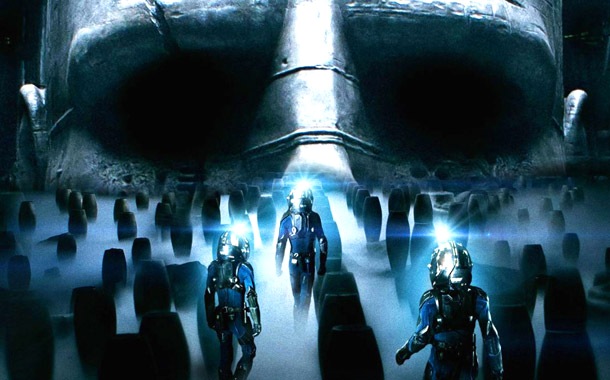
The sections of the space race made me think of the universally shrugged-at Alien prequel Prometheus.  Here's Graeber:


"The American victory in the space race meant that, after 1968, U.S. planners no longer took the competition seriously. As a result, the mythology of the final frontier was maintained, even as the direction of research and development shifted away from anything that might lead to the creation of Mars bases and robot factories.

"The standard line is that all this was a result of the triumph of the market. The Apollo program was a Big Government project, Soviet-inspired in the sense that it required a national effort coordinated by government bureaucracies. As soon as the Soviet threat drew safely out of the picture, though, capitalism was free to revert to lines of technological development more in accord with its normal, decentralized, free-market imperatives—such as privately funded research into marketable products like personal computers. This is the line that men like Toffler and Gilder took in the late seventies and early eighties.

"In fact, the United States never did abandon gigantic, government-controlled schemes of technological development. Mainly, they just shifted to military research—and not just to Soviet-scale schemes like Star Wars, but to weapons projects, research in communications and surveillance technologies, and similar security-related concerns. To some degree this had always been true: the billions poured into missile research had always dwarfed the sums allocated to the space program. Yet by the seventies, even basic research came to be conducted following military priorities. One reason we don’t have robot factories is because roughly 95 percent of robotics research funding has been channeled through the Pentagon, which is more interested in developing unmanned drones than in automating paper mills."

One of the many clueless elements of Prometheus was the introduction of Guy Pearce's eccentric billionaire Peter Weyland (it's Weyland Corporation that sends out exploratory mission in later Alien films), who has apparently funded a multi-billion dollar project to discover the origin of the species.  The assumption is that he's somehow done this through R&D at Weyland Corp. and not out-of-pocket, but, as Graeber's article points out, it's highly implausible that shareholders or board members would ever let the project get that far (particularly given how secretive the whole ordeal appears to be).  Along with the notion that all the proven evidence of evolution appears to be bunk, the idea that capitalism would take a leap of faith and loan out seed money towards a  high-risk, no-profit, zero-yield expedition requires a massive suspension of disbelief on the part of audiences.   Of course, Weyland still turns out to be hideous, and not just Pearce's atrocious makeup job.  But his failing is less driven by professional ambition than personal vanity and narcissism, making the film far less interesting than the film it loosely precedes.

What was unique about the original Alien at the time, coming out in the wake of Jaws, 2001, and Star Wars, and appearing to piggyback on them, was how it followed in the post-Cold War logic described by Graeber in the article linked to above of anticipating the privatization of deep space exploration which never came.  Only in Ridley Scott's original vision, this was not necessarily the result of a victory of the imagination, but a market-driven imperative.  The attempt to capture the titular Alien, who has developed the ultimate defense mechanism (acidic blood), is a military expedition, the goal being to weaponize the Alien and use him against the home country's enemies.  Though this is the primary mission, the objective is hidden from the team, who are mere technicians on the trip, physical rather than mental labor who think they have been sent on a mining trip.   In fact, the only one who knows the crew's true goal is a cyborg, Graeber's robot worker who was supposed to replace the labor force, but is here only used for insurance, as well as the administrative review of the unpredictable humans on board.


On board the Alien ship Nostromo, the lights flicker,  things break down, and grime is on everything. This placed the film in stark contrast with Star Wars, whose future was somehow impeccably clean and flawlessly operational. In Alien, it's the future, where commercial space travel is an option, but still, nothing works. Even the food is terrible.  The market hasn't made these ships any more durable and the infrastructure of labor relations seems to remain completely in tact.  In other words, the future is just like now, but with space trips and robots. 

Soft Control


here's a mini-review I wrote of Slava's new EP Soft Control

Wednesday, June 13, 2012

What Happened to You?


I wrote about the newest Minimal Wave Tapes compilation (a while ago and then it got published today):

"When asked about the influence of these buried-to-the-point-of-near invisibility curiosities on his current project, minimal synth torchbearer Sean McBride of Xeno and Oaklander and Martial McBride said, “It was as if these groups were writing soundtracks to a film depicting their own extinction.”  Two years after the release of the aforementioned compilation, minimal wave’s spotlight moment may have passed, but it is now in the precarious position of not having been forgotten."

Here's a couple other things I wrote about minimal wave a few years back:


* Things We Were Due to Forget: The Cold Undertow on Minimal Waves

* The Minimal Waves Volume 1

Tuesday, June 12, 2012

Get Get Get Got Got Got Got


RE: the whole "It's okay to not like things...but don't be a dick about it" conversation, I've found that the latest in shirking-off criticism- notorious amongst music critics especially- is stopping short of "not liking things", but instead saying "I don't get _____".  Just saw a fellow critic tweet that "I don't get Charlie XCX".

 I guess this is a stand-in for saying you don't understand said artist's appeal, but since when has that been the endgame for criticism?  If you're talking about Charlie XCX's music, there's not a whole lot to get.  As pop, it's largely music that's more about surface than depth.  This line of thinking gives power to the percieved audience alone and undermines one's own rationale as a reliable source.  It assumes that there must be some talismanic charm to the music itself that escapes you (and other folks "get") and you wish to be excused from having to examine this in more detail.  In other words, it's a cop out for someone who just doesn't like things.  But it's okay to not like things.  And your job as a music critic is to tell us why.  

Perhaps the worst case of this sense of total dismissal was a piece posted at Vice (big surprise) a while ago wherein the author, who apparently was able to BS his way into an art degree, now admits that he doesn't "get" art (using the unfortunate example of Tracey Emin).
The article. says far more about Emin than "art". To say that brit sensationalist hacks represent "art" in general is small-minded and dismissive. Emin is all immediacy, surface, and no substance (not unlike Vice to be honest), but to shrink this critique to "art is only valuable if you 'get' it" is dangerous in that it raises the potential to denigrate art to exactly what Emin does and nothing more. The problem with Emin for me is that I get it all too well. It just doesn't make me care.

There are definitely valid criticisms of the works, the setting, the intended audience, and the actual audience involved in this exhibit. no doubt. But the article essentially boils down to the inescapable credibility grab (I wrote about Bordieu in art school!) followed by a series of Gawker-ish balks of "Hey look at these dum-dums who actually like this stuff". It's indicative of the type of trolling snark Vice regularly pawns out to people who couldn't be bothered to care about anything, putting me in the uncomfortable position of defending an artist I think the world has already wasted enough ink and thought on.

The Vice piece assigns its author's resentiment to art in general on the basis of a particularly lousy exhibit and thus lets himself off the hook from having to analyze the broader context of what exactly art, and specifically immobile, gallery-commodified art means in 2012. The author makes assumptions about audience rather than engaging with or challenging them.

In a sense, this stance is defensive, presuming that the counter-argument is "you just don't get it", which, sure, is obscurantist and dogmatic.  However, absorbing that critique and just saying "you're right, I don't get it" is a submission to worthless art on its own terms. It validates Emin, et al. to an extent, because it presupposes that something more may be there, but I'm so offended by it lack of plainclothes, speak-to-me-as-a-worthless-plebe dialectic that I just don't care. And furthermore, it suggests, any one who does care is wasting their time. For the Vice hipster, it's more important to be above it than in it. It's more important to not get it and be dick about it than risk the possibility of not liking it and being a dick about it.


BTW, kinda like this song:


Monday, June 11, 2012

Game Over


I have a new essay over at PopMatters examining why summer blockbusters now seem to be required to murder scores of innocent people as a prop (focusing specifically on The Avengers):

"Who better than the films to reactivate and “master” trauma than Hollywood? Hollywood may not be able to prevent the world from tumbling down, but it can save John Cusack’s family in 2012 or the woman who works at the coffee shop in The Avengers. It’s perhaps this primal repetition compulsion that keeps driving audiences back to the multiplexes for more acts of apocalyptic grandeur in the wake of September 11th. It’s a place where we aren’t forced into the complexity of the aftermath, but can revel in the brutal act’s immediate closure and resolution as a remastered event."


Other thoughts brewing around in my head at the time I wrote this:


-The way “games” has become common parlance for control systems, as in The Hunger Games, Game of Thrones, and The Wire. Though these games are often seen for what they are- manmade constructs, they’re also seen as somewhat insurmountable. In each of these instances, the only option within the game is “to play”.   In the Hunger Games, the games are played because of implied spectatorship, and because no one would want to substitute themselves as "tribute".   In Games of Thrones, the game appears to be something a rotating crop of aristocratic dynasties devise to retain power, but the actual game is being played on the commoners caught in the crossfire while an arbitrary king or queen is substituted for a new one.  In The Wire, the game is the system itself, upheld by the institutions that benefit from its perpetuation.  This game is the ultimate approximation of capitalist realism, which Zizek in his fairly jumbled recent speech on The Wire, rightly pointed out that David Simon agrees with; there is no alternative, so in order to win, get ahead, stay alive, or outwit your competitors, you have to accept the game's inherent rules.


- Apparently, cities get blown up in G.I. Joe 2 and Transformers 3. I remember G.I. Joe being the show from my youth where, comically, everyone was shooting all the time and no one ever got shot, which is what made the minor bits of blood in the G.I. Joe animated film so shocking. When did it become okay to sync the franchise with all this nastiness? It’s as if the stakes can only be apocalyptically high. Where does the action blockbuster go from here though if they’re already destroying half of the world? How will the next villain top this? How close are we to seeing a marriage of Roland Emmerich devastation porn and Eli Roth/James Wan style torture porn?


- From a musical perspective, it’s notable to point out that GI Joe 2 is being promoted with a Glitch Mob brostep remix of “Seven Nation Army” in its ad. Couldn’t help thinking that these films satisfy the same kind of desires (constant stimulation, bigger and more explosive, manufactured tensions (imagine the drop coming in just at the moment the building is about to fall), populism vs. art, violence vs dance) that Bassnectar style EDM does.


Initially thought this was another toy franchise in the devastation porn genre that had that song- Battleship. Turns out that one does have a trailer with some wobbly dubstep too:


Speaking of which, Simon points to a post by Leaving Earth on the best of this breed and there's much to be cheered in some of these, which suitably fit the acid/gabber/industrial legacy of atonal pop avant garde (still think Borgore is repulsive though).

Friday, June 8, 2012

The First Time Ever I Saw That NSFW Video

I'm not one to revel in or comment on or care about or be bothered by or give any kind of additional press to petty internet gossip, but the Wayne Coyne v. Erykah Badu debacle raises some concerns that I've had throughout the years as a Flaming Lips fan

I love The Flaming Lips and Coyne seems to be a genuinely warm, interesting, and vibrant fellow.  He's capable of inspiring wild optimism with songs about death, aging gracefully by continuing to explore new paths, and executing one of the must energetic and affirmative live shows on  the planet.  Though it's far from album of the year material (see the previous post), Heady Fwends is a hoot, a collaborative session that sounds like inspired fun rather than the result of boardroom engineering, as many of these guest-flooded albums tend to be. 


Their live show is great at producing spectacle- the beaming lights, the giant hamster ball, the funfetti explosions, the bleeding headwraps, the dancing aliens and santas, and singalongs all make for great spectacle.  Yet, the cinematic component of much of the Lips's music has always been a bit disappointing. Their long-delayed home movie "Christmas on Mars" was...okay, I guess...a but subpar, even for "head" films, but the most upsetting thing about their visual component is how clumsily they often navigate from Freudian surrealism (such as their live stunt of emerging from a giant vagina) to "Man Show" style T&A.


While the more sanguinary elements of their phantasmagoric shows and videos can seem apropos at times, they often falter at the symbolic level even when they manage to penetrate at the visceral level.  Because of this, it's entirely unsurprising that Badu, in her extended tweet, should say that "When asked what the concept meant after u explained it , u replied ,'it doesn't mean anything , I just want to make a great video that everyone is going to watch. ' "

I've not actually seen the video in question so I can't comment on it (apparently, I'm not supposed to see it and I'm okay with that), but the band's insistence on doing videos by themselves (with the exception of this rather bland one offered by Sofia Copolla before she became a filmmaker of note) appears to be to their detriment.  While I'm not exactly sure what caused them to leak the "First Time Ever I Saw Your Face" video without first getting approval from Badu, the pattern of exploitation they've observed in slavishly rolling out softcore images of women has been uncomfortable observing as a fan, and not in the transgressive way in which the band thinks it is.  This is only heightened by Coyne's twitter feed, which regularly spits out these kind of images with captions like "Yep" or "Awesome!" (including pictures of his own wife, which, the assumptions is, are consensual).    Just observe the below, posted after Coyne was reproached by Badu for behaving like a pig ("As a woman I feel violated and underestimated", Badu said):


Any guesses as to which Time magazine cover he's talking about?

Coyne's responses to Badu have the air of badgering, even borderline harassment.  Having played in a rock band nearly his whole life, perhaps he is unaccustomed to a world where you don't respond by someone telling you to kiss their ass by commenting on how nice their ass is.  In subsequent dialogue, Coyne seems oblivious to just how damaging this kind of objectification is.

There seems to be a bit of a culture clash at play here too.  Not only the white male vs. black woman thing, which has its own dynamic, but that of the punk rocker vs. the professional musician  (The Flaming Lips's earliest work is collected on a compilation brilliantly titled Finally the Punk Rockers are Taking Acid).  As Badu notes:

"You also did the same thing with the song itself which displays crappy "rough "vocals by me . I let it go , perhaps iiiii was missing something, I thought.
"I Should have followed my first mind back in studio when recording the vocals 'your way'."

Elsewhere, she talks about the video compromising her artistic "brand".  Badu's world is not one that regularly accommodates abrasion or any king of "rough vocals".  She's a pop star and has been since her first album.  Decidedly, she's a bit of a retro-act.  Despite her alleged allegiance to afro-futurism, her music doesn't seem to have actually incorporated any forward-thinking ideas since the renaissance of black music in the 70s.   Coyne, on the other hand, graduated from the 80s/90s college underground where rawness and lack of polish was celebrated.  He regularly enlists David Fridmann to muddy up tracks and ramp up the dynamic range compression to make it sound like the band has blown a perfectly good set of speakers.  His vocal style can only be described as pubescent since his nasal Midwestern accent can't seem to hold a single note without a voice crack.  Compare to the trained and measured style of Badu and we're looking at a collaboration that was destined to fail without some basic communication. 

The assumption is that Coyne's art is driven by a frenzied, intrinsic need to create, whereas Badu develops and hones a craft in a professional manner.  Yet the way Coyne has guffawed at the publicity he's been getting over the stint makes him seem clownish, less the scatterbrained imaginative type who is not conscious of his actions, than a self-conscious brat exhilarated by all the attention he's getting:


"To all the haters who think Erykah Badu has lost her mind!!! She has NOT!!! The Flaming Lips take full responsibility or the making of and the content of the controversial video !!! We are very sorry if it has offended some of Erykah Badu's more Conservative audience! The video was intended for mature audiences and is NOT an Erykah Badu statement.. It is a Flaming Lips video!!!"


"You were right on! @fatbellybella you said we gonna make a video that is controversial and gets everybody talkin!You the master!! Love you"

 "Dang!!!!! @fatbellybella you really know how to do it!!!! You hatin on me has gotten the video 100,000 more views !!!LOVE LOVE LOVE"


His thrill seems completely oblivious or just indifferent to the fundamental issue at hand here: he essentially just posted porn online without the woman's consent.  Regardless of whether Badu agreed to be filmed in this manner, no one owns images of someone else's body.  If Coyne can't see why distributing personal images like this without a woman's consent is wrong, then he's just a frat boy with a megaphone and blood on his face.

Thursday, June 7, 2012

Bloods & Grips

Nothing contemporary is without precedent, but how does one go through life with an increasing breadth of knowledge about the expanding palette of the present without becoming blind to the new when it does pop up. In all likeliness, the new will never actually be holistically unheard- at least in the way electronic noises once were, but will rather defy simple categorization as a proximal amalgamation of reference points. This is the way P4K often used to review (and still does occasionally), using the musical past as metrics, ancestry as math- they're the MBAs of music, finding no problem a calculation or a McKinsey study can't answer.

John Calvert at The Quietus makes a good case for describing the phenomenal new album by Death Grips as post-punk, forging a counter opinion to those who've offered the rather simple equation that the group is hip-hop with punk energy (these critics would do well to look back at writing from the 80s, which all used the lazy shorthand of referring to rap music as the "new punk rock"). Yet, while I see where Mr. Calvert is coming from, the things I hear in the record- which has its own thunder to unleash and need not hoard it from any retro-aggro-vault are far more recent audial samplings.

What I hear:

Wobbly brostep
Alec Empire digital assault patterns
Terminator X atonality and hypersonics
MIA franticism
Vex'd's early whip-crack scorched earth dubs
Techno Animal and Mille Plateaux's Electric Ladyland comps trip-n-scrape-your-knee-hop abrasion
Daniel Martin McCormick's barking vocal style on early Mi Ami records
Wonky's broken-and-reassembled-scotch-tape beat
Noise/post-noise textural grit n' shit
Mouthus-ish machine gun assault
The industrial-ish ragga of early tracks by The Bug  or DJ Rupture mixes like Gold Teeth Thief
Actress/Zomby epilepsy
'Nuum-fueled sample vocal science
The Butthole Surfers's disjointed psychodelia
Slick use of machinal loops a la Nine Inch Nails
The CD-skipping quality of footwork
The glitched out Kid606 remix of "Straight Outta Compton"

RIP Ray Bradbury

When I read the Martian Chronicles in middle school, the story where Spender abandons his own crew to explore and possibly preserve Martian culture ("The Settlers") was so mind-blowing to me in so many ways:

-The way it showed how important independent thought is, how important it is to forge our own personal perceptions of the world and reject traditional realities, even if no one else will listen or pay attention. Even if (or maybe because) every trace of you will one day be gone

-Its particularly harrowing way it tied fiction to history, recalling the colonial story of America in a way that didn't just provide an interesting parallel, but instead applied a sense of apocalypticism to our own time, showing that we're all standing on rubble and our luxury is built on the graveyards of those who would never enjoys such fruits.

- The way it showed a civilization with a greater technological advantage and mental capacity than ours still struggling to reconcile their fears, showing that "progress" is not always a straight line to freedom

- The way that Captain John Black consented to Spender's assassination, despite essentially agreeing with him and offering nothing to prevent the erasure of an entire civilization

-The way it showed my still developing mind that there was nothing about the good guys that made them inherently good, that they were just as capable of great evil.

-The way it flipped the dynamic between every other piece of lit I had read up until that point and proved that the written word could realign people like that, shake them out of their sleep and force them to stay up late at night thinking about what they'd read. It made thinking less of a chore or an exercise and more of an intrinsic necessity. Before this, I had never been hungry to read more in a way that didn't just satisfy some constant need for gratification/stimulation. It made me want to be challenged.

-The way it made me feel this kind of dizzying and exhilarating confusion. The way it made me feel like Spender, lost but liberated, alone but assured in my solitary path. It made me realize that in order to fill an honest life, I would have to go it alone more often than not. It was the first time where I felt the root word in "alien"ation. I've felt pretty much like an alien ever since, finding it difficult to identify with practically any one around me, feeling like my "people" are some remote civilization, only to be found in odd corners of the world, hiding in the shadows at concerts, stuck in low pay jobs, and scattering the fringes of the internet, deliberately pushed to the side by an indifferent culture trying to make them disappear.

It'd be pretty hard to argue that Ray Bradbury isn't singularly responsible for the person I am